
Key Pointers:
- Aphantasia is the inability to form mental images, affecting how people imagine or recall
- It is not a disorder but a natural variation in brain
- People with aphantasia think conceptually rather than visually and can still be highly creative and capable in various
Imagine being asked to picture a beach, the soft sand beneath your feet, the gentle rhythm of the waves, and the golden sun setting on the horizon. For most people, this mental exercise produces vivid imagery in their mind’s eye. But for some, no matter how hard they try, there is only darkness or blankness. This phenomenon is known as Aphantasia, the inability to voluntarily visualize mental images.
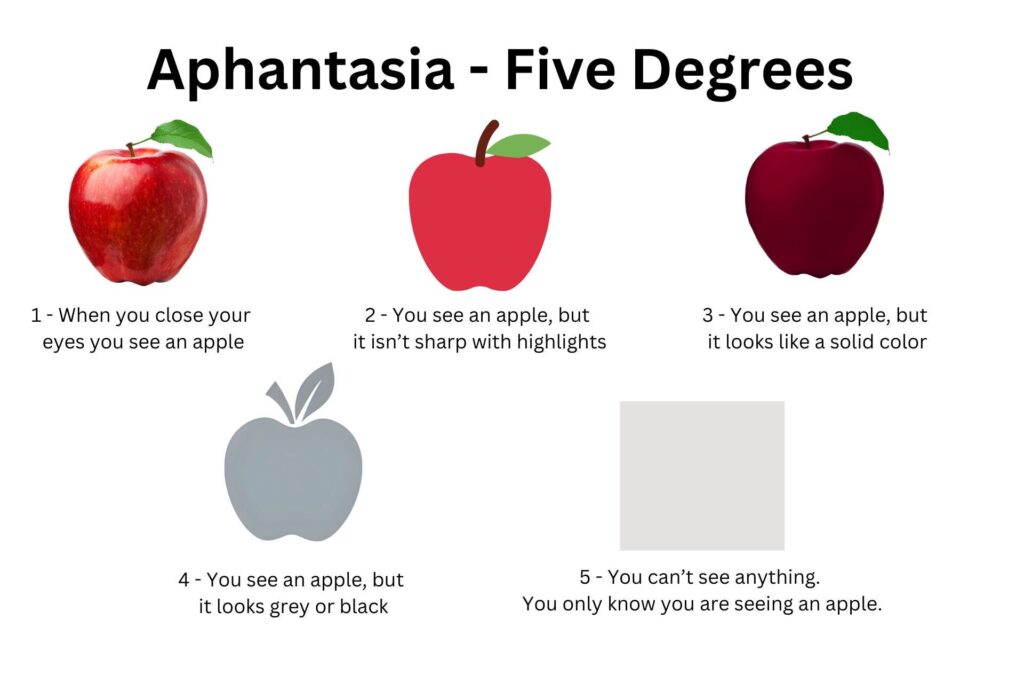
Aphantasia is not a disease or disorder but a variation in human experience. The term was first coined by neurologist Adam Zeman in 2015, although the concept had been mentioned as far back as the 19th century. People with aphantasia report that when asked to “visualize an apple,” they cannot form a mental picture. They may understand what an apple looks like, can describe its features, and recognize it when they see one, but they cannot see it in their mind.
Interestingly, people with aphantasia usually realize they have it only when they discover that others can “see” things in their heads. Many describe a sense of surprise upon learning that mental imagery is common and that their experience is atypical. Despite this difference, most individuals with aphantasia function perfectly well in daily life. They can recall facts, navigate familiar places, and remember people, but their memories tend to be more conceptual than visual.
Researchers distinguish between voluntary imagery (creating pictures in the mind intentionally) and involuntary imagery (such as dreams or flashbacks). Some people with aphantasia cannot visualize voluntarily but still dream vividly, while others lack mental imagery entirely. This suggests that aphantasia exists on a spectrum rather than as an all-or-nothing condition.
The exact causes for aphantasia is still not known. Brain imaging studies suggest that people with this condition may have differences in the neural pathways connecting the visual cortex (which processes images) and the frontal cortex (involved in planning and imagination). Essentially, the “visualization circuit” may be less active or less connected. However, cognitive abilities such as creativity, memory, and problem solving are not necessarily impaired. In fact, some individuals with aphantasia excel in fields like mathematics, engineering, or writing, where abstract or verbal reasoning dominates.
The impact of aphantasia varies from person to person. Some feel unaffected, while others say it influences how they recall loved ones, read novels, or engage
with art. Emotional experiences may also differ. For instance, recalling a happy memory might bring feelings but not images.
As awareness of aphantasia grows, so does empathy for the diversity of human thought. Understanding that not everyone thinks in pictures challenges common assumptions about imagination and creativity. It reminds us that the mind’s landscape is vast and that even without images, our inner worlds remain rich, complex, and deeply human.