
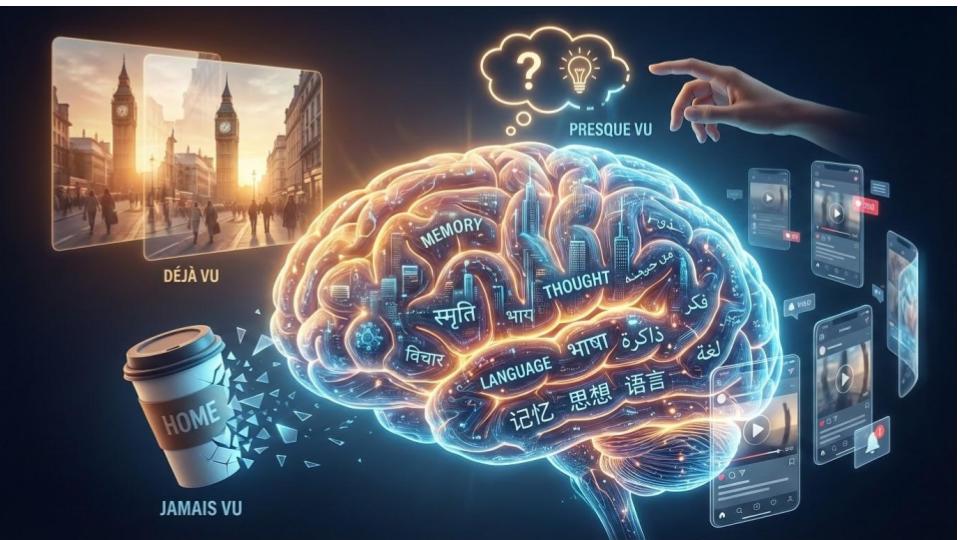
The human brain prides itself on being a brilliantly efficient machine—until it suddenly behaves like a confused intern hitting repeat, refresh, or loading for no reason. Among these fascinating cognitive hiccups are déjà vu, jamais vu, and presque vu. Each of them bends our sense of time, memory, and recognition just enough to make us wonder whether our mental wiring momentarily tripped over itself.
Déjà Vu: The Brain’s Accidental Replay Button
Déjà vu, often described as a moment where the present feels like a memory, is believed to arise from tiny neural delays. When the brain receives the same piece of information twice—milliseconds apart—it mistakes the second arrival for a stored memory.
Think of it as your mind accidentally double-sending itself an email.
This memory echo isn’t a sign of anything wrong; instead, it reveals how fast and sensitive our neural circuits are. The emotional tone of déjà vu tends to be warm or familiar because it brushes against regions connected to emotional memory.
Jamais Vu: When the Familiar Feels Foreign
Jamais vu is the eerie opposite—a moment when something well-known suddenly feels strange. A common example is repeating a word until it seems unreal.
This is the brain’s equivalent of a factory reset.
Overstimulated or exhausted cognitive systems may temporarily switch off the “familiarity” signal to prevent burnout, conserve energy, or reorganize memory pathways. That’s why jamais vu can feel unsettling: it’s not forgetfulness, but the brain briefly withholding recognition cues.
Presque Vu: The Almost-There Moment Before Insight
Presque vu is the tension of being on the verge of remembering something or having an idea—often called the tip-of-the-tongue state.
Rather than being a retrieval glitch, presque vu often means the mind is:
aligning cognitive pathways
activating semantic networks
preparing for a creative or insightful leap
In other words, near-forgetting can sometimes be near-genius.
Why These Glitches Multiply in Multilingual Minds
For bilingual or multilingual individuals, switching between languages can create semantic interference. Multiple memory systems compete for access, causing:
brief déjà vu (familiarity hiccup)
brief jamais vu (recognition drop)
delayed word retrieval (presque vu)
The more languages the brain juggles, the more chances for tiny timing mismatches—yet this flexibility also makes multilingual brains more resilient and creative.
The Emotional Personality of Brain Glitches
Each glitch comes with its own emotional flavor:
Déjà vu → warm, nostalgic, oddly reassuring
Jamais vu → eerie or disorienting
Presque vu → frustrating but often productive
These feelings arise because memory, recognition, and emotion share interconnected neural networks.
Digital Age: Why We Feel These Glitches More Often
Today’s content loops—reels, memes, resurfaced videos—create an artificial déjà vu. Algorithms repeat what we’ve already seen, tricking the brain into believing it remembers an event or moment independently.
Combined with modern overstimulation, rapid task-switching, and language mixing, it’s no surprise our brains occasionally glitch like a smartphone with too many apps open—yet still impressively functional.
#DejaVu #JamaisVu #PresqueVu #MemoryGlitch #BrainGlitches #CognitiveScience #Neuroscience #BrainLag #MindPhenomena #HumanBrain #PsychologyFacts #MemoryScience #CognitiveMysteries #TipOfTheTongue #BilingualBrain #MultilingualMind #SemanticInterference #DigitalOverload #ScrollingCulture #InformationFatigue #NeuroArt #BrainIllustration #ScienceCommunication #NeuroInsights #MindExplained #CognitiveOverload #BrainFunction #NeuralPathways #CreativeThinking #MentalModels