
Key focus:
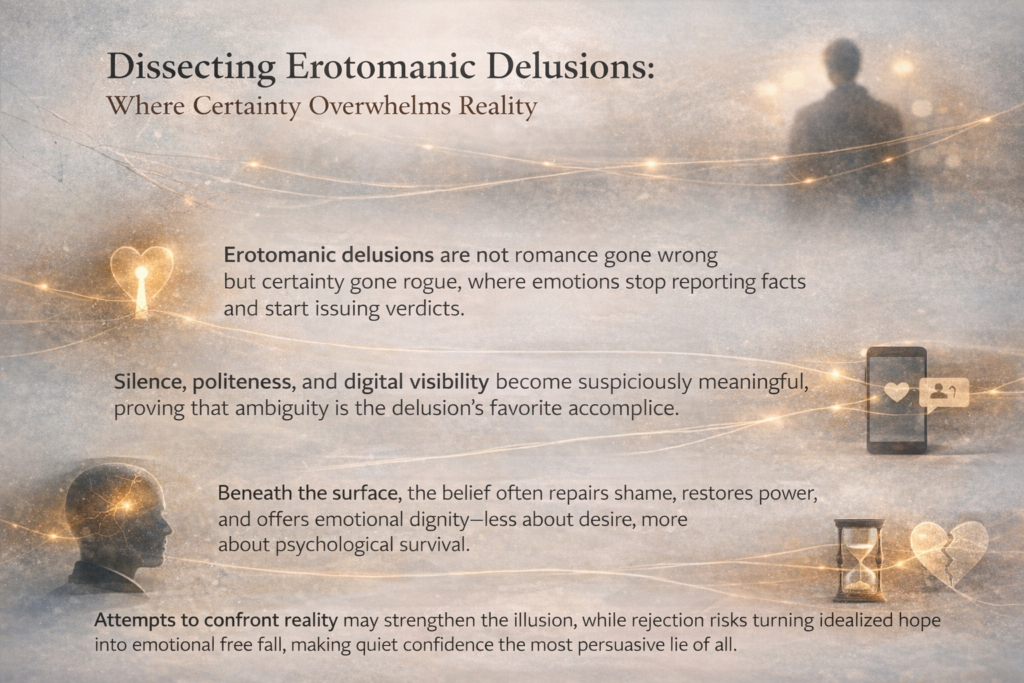
- Erotomanic delusions are not romance gone wrong but certainty gone rogue, where emotions stop reporting facts and start issuing verdicts.
- Silence, politeness, and digital visibility become suspiciously meaningful, proving that ambiguity is the delusion’s favorite accomplice.
- Beneath the surface, the belief often repairs shame, restores power, and offers emotional dignity- less about desire, more about psychological survival.
- Attempts to confront reality may strengthen the illusion, while rejection risks turning idealized hope into emotional free fall, making quiet confidence the most persuasive lie of all.
Erotomanic delusions are commonly mistaken for overblown romance or misplaced lust. However, they actually represent a complex and intriguing disconnect between emotional conviction and the world outside. The thinking process, in these cases, is more akin to that of an overbearing storyteller than a meticulous researcher, selectively adjusting facts to support a predetermined ending. It is crucial to comprehend this process not for shock value but for insight.
The root of this condition is a fascinating thing: the certainty that is indistinguishable from love. In erotomanic delusions, emotional conviction is its own proof. Emotions are considered evidence, not data to be analyzed. Reassurance, rejection, or reason are ineffective not because they lack potency but because they are irrelevant to a belief system that has already declared emotion supreme. Logic raps gently; certainty has already barred the door from the inside.
Silence adds further layers of complexity. Neutrality, late responses, or professional politeness are not registered as silence but as coded messages. An unanswered call could be an expression of control, a lack of response could be a sign of coded allegiance, and politeness could be confused with intimacy in regulation. Ironically, the less direct the interaction, the more space there is for imaginative certainty to thrive.
The digital space accelerates this process. Algorithms that reuse familiar faces, publicly visible posts, and parasocial exposure make it difficult to distinguish between personal significance and random chance. A viewed story or a regular appearance in a feed is a sign of symbolic confirmation, turning automatic visibility into perceived intention without any actual interaction.
Crucially, however, erotomanic delusions are rarely simply about desire. They frequently involve themes of shame correction, reversal of power, and emotional rescue. The delusional belief provides dignity where there was shame and importance where there was neglect, and this provides a narrative that is perceived as stabilizing, even noble.
Confrontation, while tempting, is often ineffective. Challenges to the belief may be incorporated into the delusional system as persecution, which will actually serve to strengthen the belief rather than weaken it.
But when the perceived rejection finally breaks through this conviction, the emotional crash can be dramatic. Idealization can turn toxic to anger, despair, or grievance, and this is a very dangerous place for emotional distress and dysregulated behaviour.
Erotomanic delusions teach us that the brain does not always malfunction loudly. Sometimes, it simply whispers with conviction, and this is the most difficult delusion to shake.