
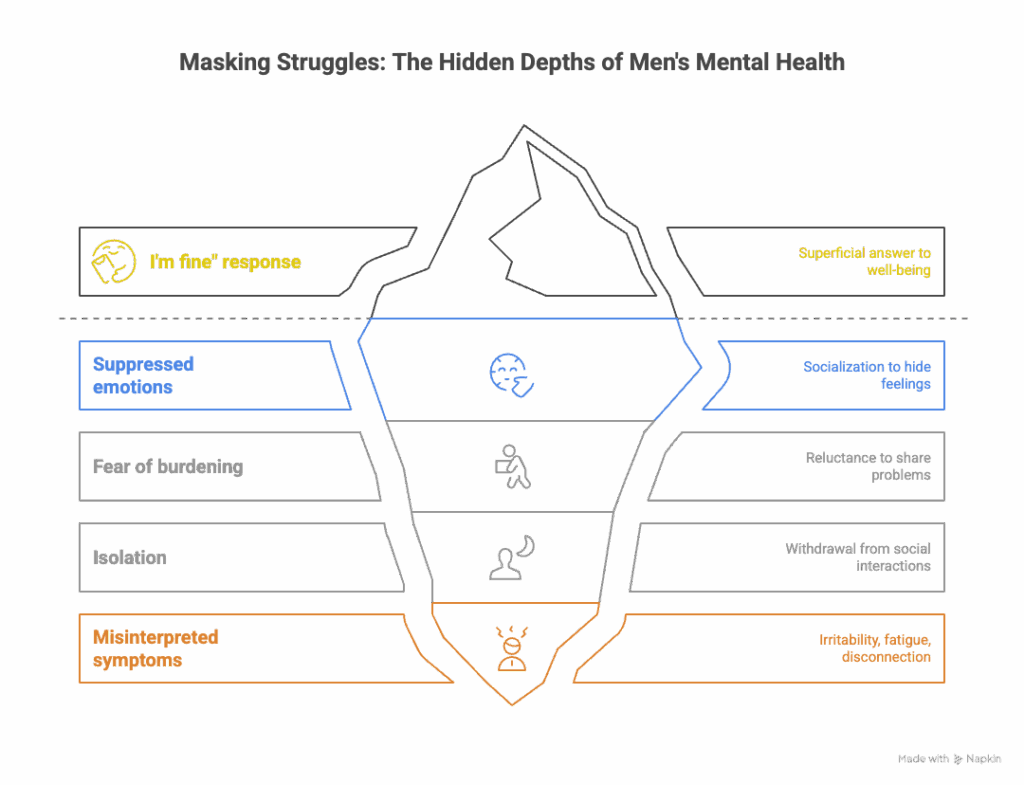
Key takeaway:
• “I’m fine” often masks unspoken struggles in men due to fear of burdening others.
• Men are socialized to suppress emotions, leading to silent suffering and isolation.
• Depression in men may not look like sadness—it often shows up as irritability, fatigue, or disconnection.
• Opening up even slightly can help identify who truly cares and is safe to talk to.
“How are you?” These three simple words carry with them a certain weight and yet they get lost in daily pleasantries. They become something automatic that we ask and respond to in our daily life. Yet, these three words are a lifeline in times of distress, multiple lifelines that we receive every day to reach out and ask for help. However, the sad reality for most men will be that they would not have the opportunity to respond to this question with anything other than “Oh, I’m fine”. At some point, we must ask ourselves, do we even know what ‘fine’ is anymore.
You’ve probably said it today. It’s short, safe and you won’t have to be bothered with a follow up. Often, I’m fine has an alternative meaning and it’s different for each person. It could be I’m fine (I’m doing well), I’m fine (I’m tired but I’m managing), I’m fine (I’m having a hard time but I can’t express it). So what is it that stops a man from being candid when given that question. Of course, we can mull over the societal pressures and stereotypes surrounding the way men must behave. But on a personal level, this will manifest a bit differently. One of the most common ways this manifests is the fear of burdening others. You feel like you’re being dramatic and that there is no reason to tell someone what you’re going through. If you’re someone who’s been ridiculed for your problems, you will also fear being ridiculed and invalidated for it. Every single time you say “I’m fine”, you may be indirectly telling yourself that your emotions don’t matter, your struggle doesn’t deserve attention and you have to do it alone.
Over time, this mindset pushes you into isolation—not just from others, but from yourself. You stop reaching out, you withdraw from conversations, you convince yourself you’re “just tired” or “just busy.” This leads to behaviours like emotional distancing, overworking, or shutting down socially, all of which feed into a deepening sense of loneliness. And without realizing it, these patterns start forming the quiet architecture of depression. But the tricky part is: it doesn’t always feel like depression. For many men, it doesn’t arrive with overwhelming sadness. Instead, it shows up as irritability, fatigue, loss of interest in things you once enjoyed, or difficulty concentrating. You might feel numb, disconnected, or constantly on edge—but brush it off as stress or burnout. These symptoms are real, but they’re often misinterpreted. Misread by others, and more dangerously, misread by you. And because they don’t “look” dramatic or obvious, they often get ignored until they’re too heavy to carry.
So what’s something we can try to do as a small step towards growth. You can always leave a door open for someone you care about. The nature of pleasantries is Yes maybe the other person doesn’t really care and was just asking you. But maybe instead of saying “I’m fine.” Perhaps you can say “Not 100%, but I’m managing”. You leave the door open for the other person to say “Oh, I see, take care” and then you can both just move on with your lives. Or you will find
the right person who will ask you what’s going on? These are the people you need to keep around because they are the ones that care. Responding to “What’s going on”? is a daunting barrier in itself and when asked the first time feel free to reply “Don’t really feel like talking about it right now”. But now you know who is there for you and who cares for what you’re going through. Keep these people close and build yourself up for that moment to share once you truly get to know them.
Being fine is something we all aspire to be but we aren’t going to get there by faking it till we make it. Real strength isn’t about never cracking — it’s about knowing when to stop patching leaks with silence. It’s having the guts to hit pause, to drop the mask, and say:
“I’m not ok right now, but I’m not going to stay like this.”
Because surviving isn’t living. And you deserve so much more than survival mode.